
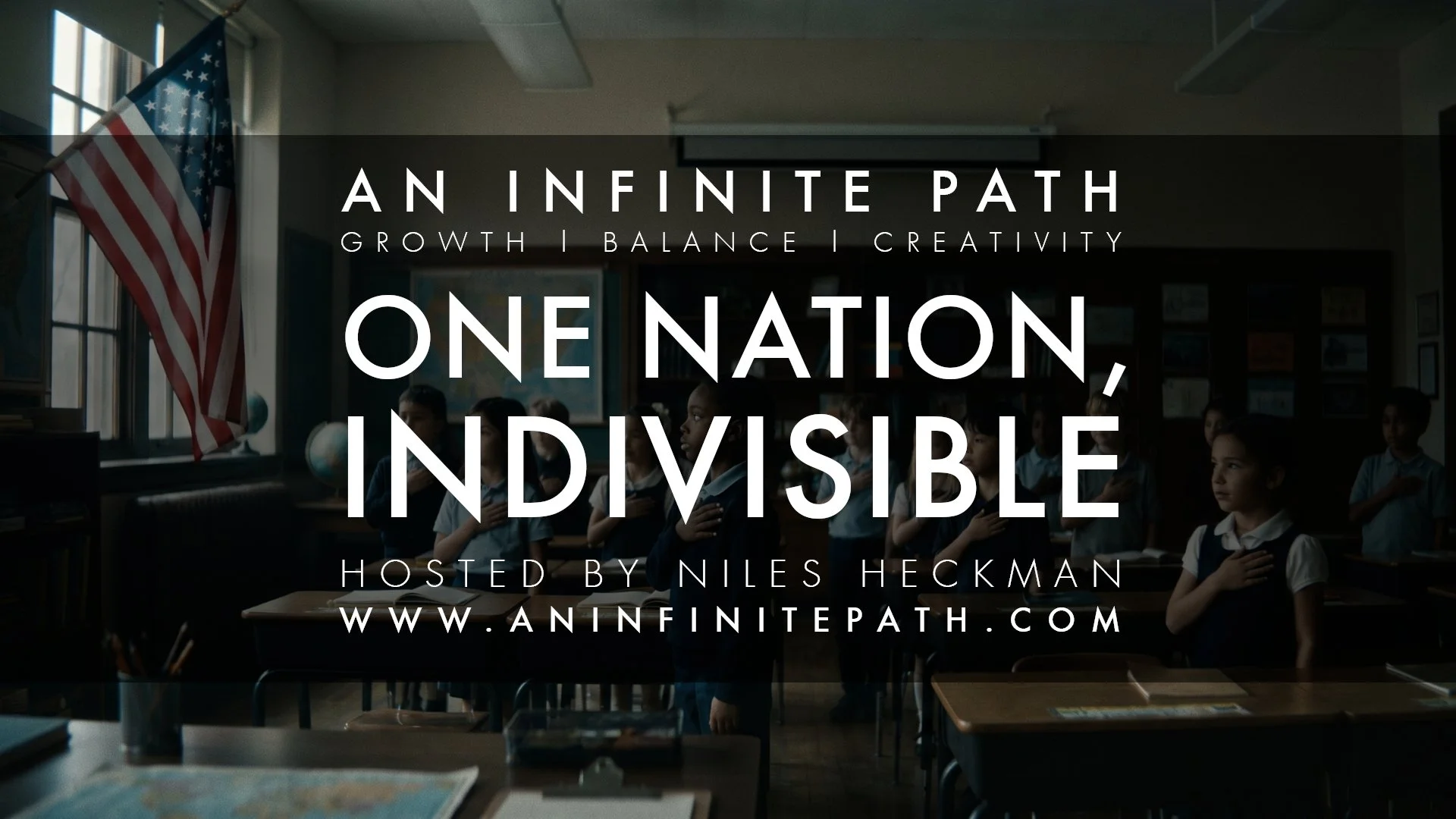
At its core, a pledge is an act of binding the self through the spoken word. In lesser known esoteric traditions, speech is not treated as casual; it is creative and formative. To declare something aloud, especially in a repeated, formalized way, is to impress it upon both the individual psyche and the collective field. In the ancient world, this would be called an oath, and oaths were never trivial. This is why presidents have to take an oath. They were and are still understood as acts that linked the speaker to a principle or cosmic order. And if violated, well...
It is a curious thing that language, mere sound shaped by the tongue, can become a ritual of such enormous psychological gravity. The Pledge of Allegiance of the United States, recited by children in classrooms before they have any real conception of the world, is not simply a benign civic exercise. It is, in many ways, an initiation into a narrative. One that quietly encodes assumptions about authority, identity, and the structure of the world. When one says “I pledge allegiance,” they are not merely expressing affection or appreciation. Allegiance is an ancient and heavy word with feudal overtones. It implies a bond of loyalty between subject and supposed sovereign. It is not the language of liberty or free association; it is the language of hierarchy. And so, from the very first phrase, the individual is placed into a relationship. Not with a community of living people, but with an abstraction: a flag, a symbol, an idea crystallized into iconography.
Now consider the structure of the Pledge:
It is recited in unison (group synchronization)
It involves a gesture (hand over heart)
It is directed toward a symbol (the flag)
It affirms unity and identity (“one nation… indivisible”)
From a ritual perspective, these elements matter. The symbol - the flag, functions much like banners in older traditions. A symbol condenses an abstract idea (nationhood, history, ideals) into a visible form. Now, symbols are not trivial things. They are the carriers of cultural DNA both the good, and unfortunately, also the bad. The light and the shadow. So they are a focus point for attention and meaning for the whole spectrum of a nation's actions. The flag represents not just a set of principles, but a historical process - betterment, economic ambition, and far too often expansion and empire. To pledge allegiance to it is to align oneself, consciously or not, with the totality of that process. It is to say, “I am part of this structure, and I affirm its legitimacy.” The United States has made a lot of progress over the decades, but also has had many setbacks - being regress. Although having founding documents which come out of enlightenment ideals, it is also still a militarized empire which was originally built on the backs of both hard work and slaves. Empires are supposed to be something else from older and darker times but if one truthfully looks at modern patterns of the United States waning but still going global military presence, global economic influence, and oftentimes cultural dominance, it begins to resemble what earlier ages would have had no hesitation calling imperial.
The gesture anchors the act in the body. Placing the hand over the heart subtly reinforces sincerity and emotional identification. But it was also not the original posture, as initially when first created, children were unwittingly rehearsing a gesture that history would soon render grotesque. The original salute that accompanied the Bellamy salute, introduced in the 1890s alongside the Pledge of Allegiance, involved extending the right arm outward toward the flag, palm down. In its earliest form, the hand began at the forehead (a kind of military-style salute) and then extended forward. At the time, this was meant to evoke civic unity and a vaguely Roman imperial republican aesthetic. Earnest, if a bit theatrically antique. Then came the 20th century’s great parade of uniforms and mass choreography. When Benito Mussolini popularized what was called the “Roman salute” in Fascist Italy, and subsequently Adolf Hitler adopted a nearly identical gesture in Nazi Germany, the visual overlap became impossible to ignore. What had once been a benign civic ritual in American schools now looked indistinguishable from the salute used in totalitarian regimes that were the opposite of champions of liberty. By World War II, the resemblance had become not just awkward but intolerable. Imagine school children pledging allegiance while appearing, to any sane observer, to mimic fascist allegiance rituals. The optics were catastrophic, and rightly so. So in 1942, Congress amended the U.S. Flag Code to replace the Bellamy salute with the now-familiar hand-over-the-heart gesture. This was not merely a cosmetic tweak; it was a deliberate act of symbolic distancing. The United States was positioning itself, correctly, as the antithesis of the regimes that had appropriated the outstretched arm as a sign of submission to the state. The change was driven by a brutal clarity: when a gesture becomes visually synonymous with tyranny, you don’t rehabilitate it, you discard it. One might say it was an early lesson in semiotics: symbols matter, and when they are hijacked by monstrous ideologies, they carry the stench with them. And so the hand went from being thrust outward in a rather alarming fashion to resting, quite sensibly, over the heart. Less theatrical, more sincere, and crucially, not liable to make American children look like extras in the Nazi propaganda film Triumph of Will.
In ritual work, physical posture is used to align inner and outer states. What you do with the body influences the mind. The repetition, especially when done daily by children, is particularly significant because it's one of the oldest tools for imprinting belief and identity. In monastic orders, mystery schools, and even military training, repetition serves to internalize a worldview until it feels self-evident rather than taught. Finally, there is the collective recitation. When multiple voices speak the same words simultaneously, it produces a kind of psychological, and some would say energetic, coherence. Ancient rites often relied on this principle: the group mind becomes more unified, and the individual feels themselves as part of something larger. Thus the pledge can be understood as a daily rite of civic initiation, especially for the young. It gradually shapes identity by linking the individual “I” to a larger “we,” using symbol, speech, gesture, and repetition—the same building blocks found in religious and initiatory ceremonies throughout history. Structurally, it is not accidental—it follows patterns humanity has used for thousands of years to transmit values, establish loyalty, and create shared meaning. So the pledge functions almost like a kind of soft incantation, a daily repetition that normalizes the structure it serves. It does not of course directly say “I support imperial expansion” and instead directly speaks of “liberty and justice for all” which is a very honorable and transcendental ideal. But this is precisely how powerful systems perpetuate themselves - they wrap themselves in the robes of beneficial or universal language while far too often operating through very specific darker realities.
What primarily alarms is not that such a pledge exists, or that it hides something, potentially darker, within itself, but that it is introduced so early in youth, before critical faculties have fully formed. As that bypasses skepticism and goes straight into the myth-making machinery of the psyche. Children do not parse geopolitical nuance; they internalize rhythm, repetition, and emotional tone. And so the pledge becomes less a statement to be evaluated and more a background assumption. Repetition creates belief, or at least familiarity so deep that belief becomes unnecessary. So a very young individual is very unlikely to ask, “What am I saying?” but simply says it. None of this means that participation in such a ritual is inherently malicious or that those who recite it are consciously endorsing empire. One of course does not pledge to cloth and dye or to be a slave, but to the symbol of the flag. A kind of cultural wallpaper. In this sense, it resembles religious liturgy. Not because it is theological, but because it operates on the same psychological level. Human beings live inside symbolic systems; we inherit them, we navigate them, and occasionally we question them. The real question is whether one becomes aware of the layers embedded in these rituals. Because once you see it, once you recognize that even something as simple as a morning recitation can carry within it echoes of power structures, you are no longer entirely inside it. You have, in a sense, stepped sideways out of the script. And that has a freedom in itself: it's not the rejection of symbols outright, but the ability to see through them, to understand their origins, their purposes, and their effects on the human imagination.
Speaking of religion, it's responsible for a more monovalent layering within the pledge. A layer that was built much later in the structure. Since the spiritual path is a personal one, religion should be a personal path, but when corrupted is one pushed on others. The phrase “under God” was both not on US currency or not part of the original Pledge of Allegiance for just this reason, but had those two words slipped into a civic oath as casually as a pickpocket lifts a wallet, and with about as much consent from the crowd. Originally written in 1892 by Francis Bellamy, a man who incidentally was a Baptist minister but sophisticatedly kept the pledge conspicuously secular. His version made no theological claims whatsoever. It was a straightforward oath to the Republic, not to any celestial supervisor. So good on him to leave it open just as the establishment clause and free exercise clause do in the 1st Amendment. Where you're free to not practice a religion, or practice a religion, but no single religion is supreme or government sanctioned. The addition of the words “under God” stands as one of those revealing moments when a nation, professing devotion to liberty of conscience, quietly amends its civic language to flatter a particular religious taste. It is not, as some would have it, a timeless expression of American identity. It is, rather, a mid-century improvisation — an ideological flourish born of anxiety, opportunism, and a rather transparent desire to draw a bright line between “us” and “them.”
To understand the alteration, one must begin with the original composition from 1892. It said "one nation, indivisible, with liberty and justice for all" and the amended version added the "under god" part to be "one nation, under god, indivisible, with liberty and justice for all". This is not an accident; it is evidence. It demonstrates that even a clergyman of the 19th century could distinguish between private faith and public obligation. His pledge was addressed to the Republic — indivisible, with liberty and justice for all - not to any divine overseer. It was a civic oath, not a creedal one. This degradation, because less is more, came during the Cold War, that long twilight struggle in which the United States found itself locked in ideological combat with the Soviet Union. Now, the Soviet regime was officially atheistic, being what regressives in the US would call "Godless Communists" and this provided American politicians with a convenient foil. So a false binary was created. If the enemy denied God, then America, so the de-reasoning went, must affirm God, loudly and often, lest anyone confuse the two systems. It was not enough to champion democracy, pluralism, or individual rights; one had to enlist the almighty as a kind of celestial co-signer of the Constitution. Thus, under pressure from religious advocacy groups such as the Knights of Columbus, Congress amended the pledge. Dwight D. Eisenhower, who had only recently undergone baptism himself, one might note the timing, signed the change into law. He declared that the inclusion of “under God” would reaffirm the nation’s spiritual heritage. So not only did Eisenhower not know what spirituality was, it also begs the question: if such a heritage required legislative reinforcement in 1954, how secure could it have been in the first place? What is often presented as a benign nod to tradition is, in fact, a subtle but unmistakable shift in the nature of the pledge. The original oath binds the speaker to a political order - a republic grounded in law. The revised version introduces a theological qualifier. The nation is no longer merely indivisible; it is indivisible “under God.” This is not a decorative phrase, it tips the balanced scale or free to be secular or free to be religious into being more religious. We noticed this when we were 8 years old having to say the pledge. Why is the god stuff in here? Because it's an insertion of imperial programming that places a nation and everyone in it, under a dominator hierarchy, most often defined as male, and the political community is now said to exist within a framework of this supposedly but incorrectly only XY chromosome divine authority.
And here we encounter the central tension. The very first amendment of the United States, which begins with the very words "Congress shall make no law respecting an establishment of religion, or prohibiting the free exercise thereof" is the separation of church and state. This principle does not demand hostility to religion; it demands neutrality. It insists that the state neither impose belief nor privilege one metaphysical view over another. Yet the insertion of “under God” into a daily, often school-led recitation places a thumb on the scale. Defenders of the phrase, who always happen to be members of exotic outer heavy handed Abrahamic religion, frequently retreat into the language of triviality. It is “ceremonial,” they say, “harmless,” “just words.” But this defense is curiously self-defeating. If the phrase is genuinely devoid of meaning, then its removal should provoke no outrage. And yet, proposals to re-omit it are met with fierce resistance, as though the Republic itself might collapse without this modest theological appendage. One cannot have it both ways. Either the phrase matters, in which case its imposition is questionable, or it does not, in which case its preservation is pointless. Inserting “under God” transforms what was a pledge to a political system into a subtle theological test. It incorrectly implies that true patriotism is somehow contingent upon belief, the etymology of which literally has LIE in the middle of the word, or at least verbal compliance with belief. 1/3 of the USA population is called the Christian Right, which is always trying to chip away at the separation of the Church and State is, but 2/3rd of the population, who may be secular or more more lightly handed religious (not in an end times death cult), prides itself on the philosophical sophistication of the separation of church and state. This minority rule is rather like insisting that one must whisper a prayer before being allowed to praise the Constitution. tradition, as ever, is often just the long shadow cast by unexamined assumptions. If the phrase is meaningless, why defend it so fiercely? And if it has meaning, why impose it universally, including upon those who do not share the mental operating system system? In truth, “under God” is a small but telling example of how governments flirt with religiosity when it suits them - particularly in times of fear. It does not establish a theocracy, of course, but it does smuggle a theological preference into a civic ritual. And that, for anyone who takes liberty of conscience seriously, ought to be at least mildly irritating, like finding a sermon tucked into your passport.
More to the point, the phrase places nonbelievers—and indeed believers of non-theistic traditions—in an awkward position. Participation in a civic ritual becomes, however mildly, an act of either compliance or dissent. One may remain silent, omit the phrase, or recite it with mental reservation, but none of these options is entirely neutral. The state has introduced a test—not an explicit one, to be sure, but a cultural and rhetorical one—of conformity to a broadly theistic norm. This is not persecution. Let us not indulge in melodrama. No one is being hauled off to the stocks for declining to utter the words. But it is a form of symbolic exclusion, a reminder that full-throated participation in national identity is most comfortable for those willing to affirm a certain kind of belief. For any who pride themselves on pluralism, this is, at the very least, inelegant.
By entangling itself with religious language, the state risks cheapening the very faith it seeks to honor. When God is invoked in a rote, compulsory context—recited by schoolchildren who may scarcely grasp the meaning—the invocation becomes mechanical. It is reduced from a matter of conviction to a matter of habit. One might argue that this does religion no favors. A deity enlisted for political pageantry begins to look less like an object of reverence and more like a mascot.
In the end, the phrase “under God” tells us less about eternal truths than about historical circumstances. It is a relic of a particular moment, when fear of an external enemy encouraged displays of internal unity — unity defined, in part, by off balanced religious expression. It still persists today not because it is essential, but because it has become familiar. And familiarity, as ever, is a powerful anesthetic against critical thought.
A genuinely confident nation—one secure in its principles and respectful of its diversity — would have little need to lace it's civic oaths with theological assertions. It would trust its citizens to find meaning, or not, in their own non theology or personal theology. It would recognize that liberty of conscience includes not only the freedom of personal expreinece, or non beliefe, or believe, with full freedom to refrain. And so the question lingers, quietly but persistently: does the Republic truly stand in need of divine sponsorship, or is this merely a habit acquired in a moment of ideological insecurity? If the former, one might worry about the strength of its foundations. If the latter, one might consider whether it is time to let the habit go.