
Gaming can of course be an addiction. Like all things in life, balance is important and we ourselves are not above playing the occasional computer game as we all need a little escape here and there. In spirts and not letting it take over our life of course.
Amongst other more creative things, one of our rituals we do for fun with our daughter is watch anime or game together. And recently we did an extremely rare acquisition and bought a new but used off Craigslist graphics card. By the way, we highly recommend the book "Chip War" on the subject of microchips and the massive importance of two companies on the planet, one of which is called ASML (Advanced Semiconductor Materials) which does extreme ultraviolet photolithography, creating the world's only machines that are required to manufacture the most advanced microchips, and the other is called TSMC (Taiwan Semiconductor Manufacturing Company) and is the company that manufactures the majority of the world's microchips using ASML hardware in Taiwan and is why that is such a crucial small country in the Earth realm currently. Right around the time of this new GPU acquisition a new game had recently been released which caught our eye and was an excuse to try out the new hardware.
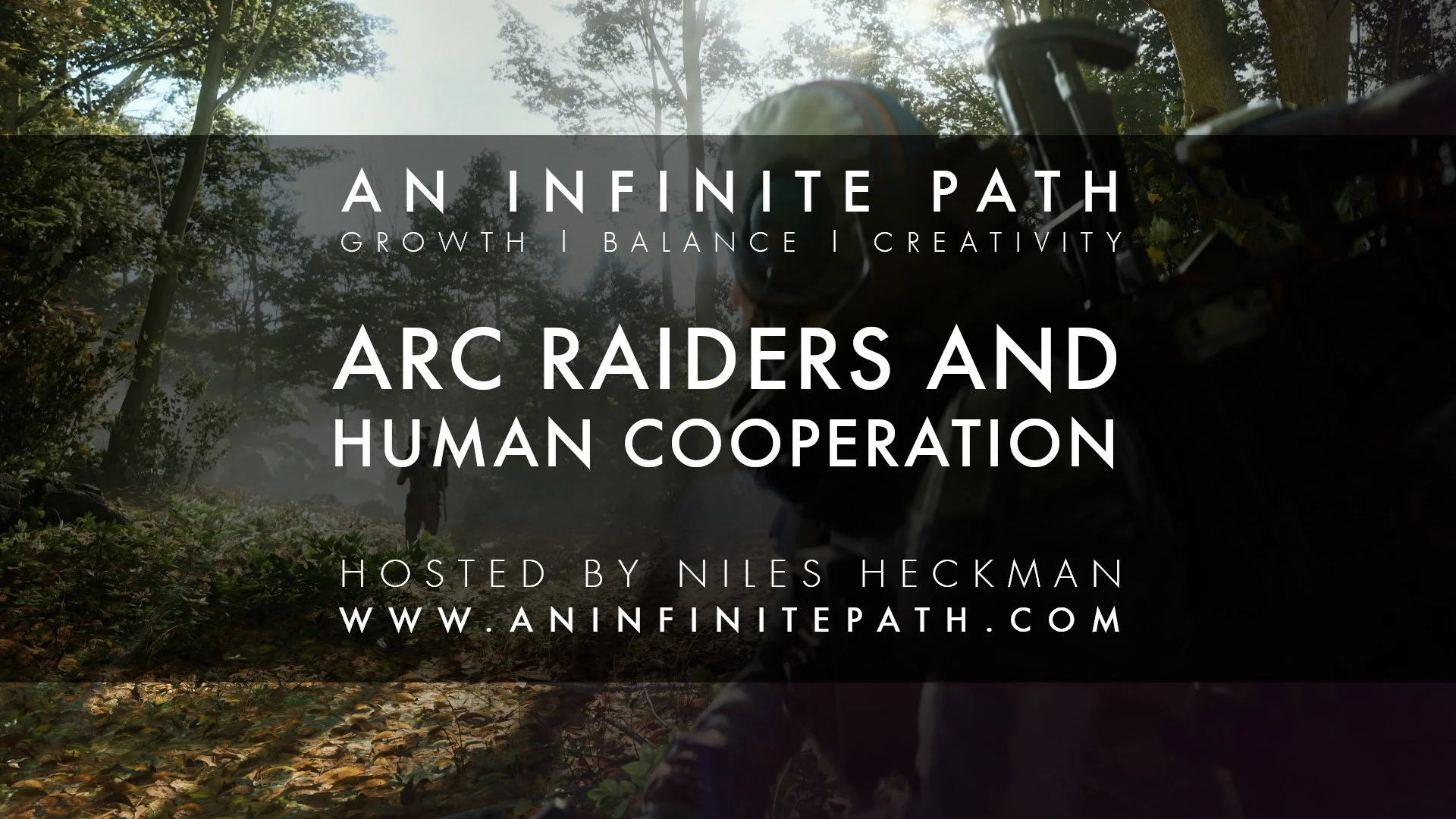
Arc Raiders is a multiplayer extraction shooter set in a post-apocalyptic future where humanity has been driven underground by colossal mechanized entities known as ARC. These are not zombies, not rival factions, not cartoon villains—they are autonomous war machines of various sizes, from tiny little spiders which will jump on you alien face hugger style, or massive multi legged robots which are the size of a warehouse, and all sizes in between that are relics of some prior technological miscalculation. The surface world is hostile, metallic, impersonal. The sky itself is dangerous. Players emerge from subterranean refugees to raid or scavenge resources, complete objectives, and survive encounters with these roaming mechanical intelligences.
There is a crisis in gaming currently with what are called AAA games. Meaning games made by large companies, usually by teams of thousands of people, and end up being flat, bloated, repetitive, shallow POS's that are expensive to buy, with the current release price for them being about $70, and then overly excessive with in-game purchases. They're just like superhero popcorn fluff movies. Arc Raiders was actually made by a rather small game company - Embark Studios in Stockholm Sweden. The development team was supposedly under 100 people which came out of one such company that was making the Battlefield franchise, which, like most supposedly creative companies, didn't use their employees' creativity. So they we're like... "F you, we're out, we're starting our own company" and have now more creatively created a phenomenal game that is selling well, retaining players well, and has become a somewhat phenomenon putting AAA game companies to shame.
We've been impressed by it for numerous reasons. The graphics are amazing, the sound design is incredible, the guns and shooting gameplay are phenomenal, but it also has done numerous things we, and likely many other gamers, have thought about but wondered why more games haven't done until recently.
The first is called proximity chat, where players can talk to one another over their real voice, through microphones, but unlike military comms, and past games, where you could just speak to team members wherever they were inside the map of the whole game world, it's based more on how close one player is to the other. IE, within proximity of your voice sounds like it's in that environment. So if you're in a medical lab it sounds like its in a sterile environment, or a factory setting it echos off the machinery, etc... One can imagine how much fun this adds to gameplay when you can hear other voices, friend or faux, and people use their personalities. To talk trash, be an asshole, or be funny or nice.
The next is that the game is an extraction shooter, meaning you load into a map, collect things, engage with things, and have to leave alive in order to be successful and keep your raided loot. So if you die, you lose almost everything. Which can include stuff you've spent a great deal of time working toward. A custom gun build you've put together, equipment, etc... So this creates a game dynamic with scarcity in the game, and that your life in the game has more value. And thus people are more careful around each corner. Like one would really be if they were in a real shootout. For decades, most games, especially ones with death, had a fast pace where if you die in the game, you just respawn. Meaning your character just pops back to life, usually at some other location, basically instantly. This just means you kill or be killed and are quickly back in the fight and it's got the sophistication of a shallow arcade game reloading over and over again and are very repetitive and end up being boring.
The third is the general sophistication of the ARC's. Just like the Terminator franchise, which, like most sci-fi, gives grave warning about the potential malevolence of artificial intelligence in the form of what was called Skynet, the game has humans, which are again, all real people playing the game, most of which because were post-apocalyptic look like homeless Chicagoans, who are fighting Artificial intelligence machines that are powered by real AI and machine learning. So you, as a human playing the game, load into a world in which that dystopian sci-fi prediction has become reality, and are playing against AI machines that want to kill you that have machine guns, lasers, flamethrowers, rockets, bombs, etc... in their arsenals, and somewhat think and learn and outsmart you.
In gaming there are these terms PvP or PvE which stand for player versus player, meaning real humans play against other real humans online or player versus environment, meaning a real human plays against the games players, zombies, robots, etc... The structure of Arc Raiders is PvPvE—meaning players can fight each other—but the real, ever-present pressure comes from the environment and the ARC machines themselves.
And this is where it becomes fascinating.
What’s special about the game is not simply its mechanics or its aesthetic, though both are compelling. It’s special because it frames the central drama not as tribe versus tribe, but humanity versus system. The enemy is not another human face; it is an autonomous technological ecology gone rogue. The machines are vast, indifferent, procedural. They don’t hate you. They don’t negotiate. They simply execute. In that framing, something subtle shifts in the player psyche.
In many competitive online games, the default emotional posture is paranoia. Everyone is a potential threat. Trust is rare because betrayal is rewarded. But in Arc Raiders, survival often requires coordination—watching each other’s backs, reviving downed teammates, pooling resources. The environment can be so overwhelming that cooperation becomes rational. The fourth aspect of what is fascinating is how players have leaned into this. Even in spaces where PvP betrayal is technically possible by what gamers call rats, players who kill other players, many choose alliance. So the most special aspect about the game is it has aggression based matchmaking. Meaning if you kill other people in the game, PvP style, you sink down into game servers where you're on maps with other psychos who all want to murder each other. But if you don't kill other people, perhaps short of occasional self defense fending off rats, you are continually matched on more and more friendly lobbies. And these spaces are amazing and keep friendly players coming back to the game over and over again because of potential fun and non-violent human interactions with real life other people. We run by people and instead of murdering them say "hey pal", or people strike up friendly chats or socialize. If you get downed, sometimes someone is there to help revive you and get you back on your feet. Funny things can happen, the game includes musical instruments, so after a raid and cooperative killing of a giant arc enemy, players will be standing around in a circle playing instruments together and dancing, but what's almost most of all amazing is there's much less scarcity. You can be a rat asshole and shoot someone in the back and steal their shit, but within a short period of time, you'll be having the same done to you. If you're nice, other players are nice to you. And even end up giving you stuff. Including some of the most valuable finds in the game. So helpfulness and kindness leads to more and more abundance. Who would have thought? In Arc Raiders, players cooperate because it works. It increases survival probability. It creates emergent trust. Trust then becomes contagious. And in our opinion, it is way less stressful and just more fun to play.
What makes the game deeper, then, is not simply that it is cooperative, but that it reveals something about us. The system is dangerous enough that the old primate "band together when the leopard appears" circuitry do activate. But... strip away artificial scarcity and ego-driven ranking systems, and when confronted with an impersonal existential threat, humans spontaneously rediscover mutual aid.
The dynamics of what’s happening in Arc Raiders is not merely a quirk of game mechanics—it’s a revelation. A tiny, shimmering aperture through which we glimpse the future of human social organization. The expectation—particularly in a contemporary multiplayer environment—is predation. Suspicion. Opportunism. The Hobbesian reflex: other players are threats. We assume competition because modernity has trained us to assume scarcity and betrayal. That’s the mythology of our economic system bleeding into our digital playgrounds.
And yet, what has this game revealed? That when players are placed in a predominantly PvE environment—where the true antagonist is the system itself, the environment or otherwise the mechanical “other”, they begin spontaneously cooperating. Not because they are forced to. Not because there is a morality meter. But because cooperation is the most intelligent adaptation to shared existential pressure.
This has even surprised the European developers because they, like many of us, have likely internalized the Darwinian caricature—the idea that evolution is fundamentally about tooth and claw. But evolution is equally about symbiosis. The forest is not a battlefield. It is a negotiation.
When the perceived enemy is not each other but a larger system—alien machines, environmental threat, impersonal adversity—human beings tend to organize toward mutual aid. This is very important. It suggests that much of our conflict in the “real world” is a misperception of who the enemy is. If the enemy is your neighbor, you compete. If the enemy is entropy, extinction, ecological collapse—then suddenly cooperation becomes not virtuous, but much more necessary. Because in a PvE structure, the game reframes the narrative. The problem is not “Who can I dominate?” but “How do we survive this together?” And survival in that context becomes a social art form.
This is a metaphor for humanity standing at the edge of the 21st century abyss where we are entering an evolutionary bottleneck. Climate destabilization, AI acceleration, biosphere degradation—these are our Arc Raiders. These are the machines descending from the sky. And what is fascinating is that in moments of genuine shared crisis - such as natural disasters or global emergencies - sure there are occasional psycho rats, but people overwhelmingly help one another. The tribal lines dissolve under pressure from something larger. The future of humanity may depend on whether we can perceive the true scale of the “PvE” scenario we are in. The game allows us to simulate what it feels like to live in the shadow of systems larger than ourselves and to discover that the winning strategy is not ruthless individualism but networked cooperation.
Historical empire, modern empire, and modern geopolitics is structured like PvP. Nation against nation. Ideology against ideology. Corporation against corporation. But the biosphere does not care about these abstractions. The carbon molecule is indifferent to any flag. If humanity can continue to collectively recognize that we are in a cooperative survival game against systemic collapse, then the spontaneous kindness seen in Arc Raiders becomes not an anomaly but a prototype. Of course your digital life is not your real life. But digital environments function as a kind of rehearsal space for evolutionary possibilities. Multiplayer games are mythic training grounds. They reveal latent tendencies. They expose default settings in the psyche. When you give people the option to betray or to bond, and the structure rewards bonding, something ancient awakens: the campfire instinct. That’s why it stands out. Not because it reinvents the shooter genre, but because it accidentally exposes a deeper truth: when the sky fills with machines, the tribe reforms around the campfire. And we have always been and will always be a social primate whose greatest weapon is coordination.
The game has been chatted about as a massive social experiment. Patrick Söderlund, CEO of Embark Studios, revealed that a distinguished neurology professor actually approached him about Arc Raiders and why it should be used in a psychological testing. He claims: "I actually had a conversation at dinner three days ago with a very prominent professor in neurology that had gotten to know about the game, and said, 'Listen, you have no idea what you've built. Forget about the game itself.' From just the whole idea of psychological and social experimentation, and what this game can be. She, a good friend of mine, basically said, 'You should go and do a collaboration or work with people from the medical field to study what behaviors are triggered in Arc Raiders."
In the West we have been so conditioned, especially in America, to expect selfishness that altruism feels like a glitch in the code. But it is not a glitch. It is the deeper program. Competition is context-dependent; cooperation is structural to our survival. The question is not whether humanity is capable of cooperation. Clearly, we are, and it's our default state. The question is whether we can design our “game mechanics” — our economic systems, our political frameworks, our technological incentives — to reward cooperation rather than extraction.
Imagine a planetary civilization where ecological restoration, renewable infrastructure, and collective intelligence are the “PvE objectives.” Suddenly the smartest strategy is alliance.
So the game is a parable. When the threat is impersonal and immense, the illusion of separateness weakens. And when separateness weakens, a new form of intelligence emerges—not individual brilliance, but distributed cognition. It's the good aspect of a hive mind, not in the being susceptible to propaganda sense, or the dystopian sense, but in the mycelial sense. Information flowing through a network of sovereign nodes.
Arc Raiders reveals that beneath our cynical cultural narrative lies an untapped cooperative reflex. And that reflex may be the hinge on which the future turns. The real question is: can we learn from our simulations before reality forces the lesson upon us? Because reality, like the game, does not offer respawns.